What Replaced Google Desktop Search? Private Options in 2026
Short answer: No single product officially replaced Google Desktop Search, which Google discontinued in 2011. Today most people use Windows Search or Spotlight, Everything for instant filename lookups, Copernic or X1 for indexed keyword search, or Fossick for offline, meaning-based search of document contents that never leaves the computer.
Free to try (1 folder, 200 files) · US$14.99 to keep · Mac & Windows
Google Desktop Search did one thing very well: you typed a few words and it found the file on your own computer, whether it was a PDF, an email or an old Word draft. Google discontinued it in 2011, and many people who relied on it have been looking for a proper Google Desktop Search replacement ever since.
This article covers what the realistic options are in 2026, how they differ, and which one fits if your files are confidential and you would rather they never touch a cloud server. We compare the built-in tools, the established desktop search apps, and a newer approach that finds documents by what they mean rather than the exact words you remember.
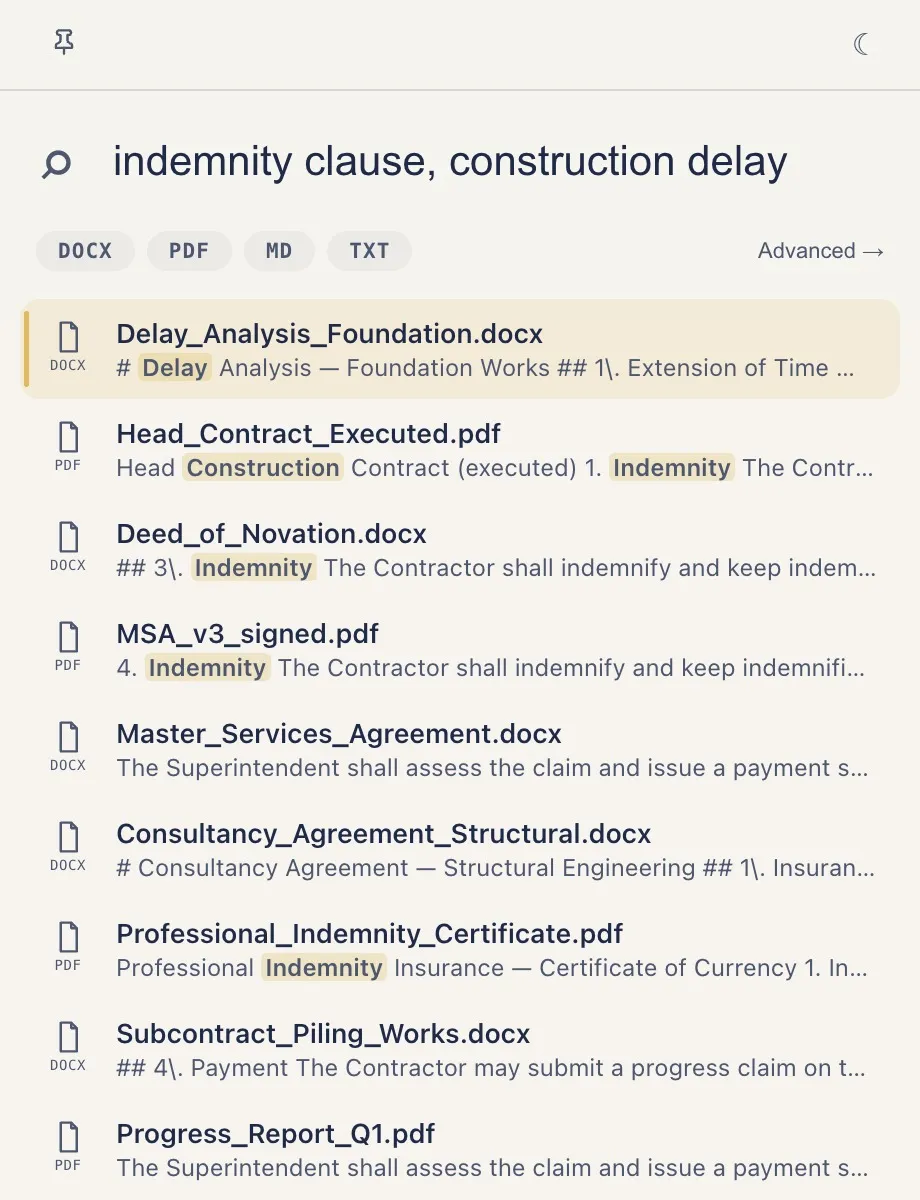
What Google Desktop Search did, and why people still miss it
Google Desktop Search brought a web-style search box to your own hard drive, and that simplicity is what people miss.
It quietly indexed files, emails and other local content in the background, then let you search them the way you searched the web: type a few words, get a ranked list. It belongs to a broader category of desktop search tools that index files on a local computer, but it was free, familiar and easy to trust at the time.
When it was retired in 2011, users were left with a few gaps:
- One box for everything. Built-in tools of that era were slower and less reliable at searching inside files.
- Ranked results. It tried to put the most relevant file first, not just list every match.
- Local indexing. Your index lived on your machine, not on someone else's server.
That last point matters more now than it did then, because many modern search features have moved into the cloud.
Is there an official Google Desktop Search replacement?
No, Google did not release a desktop successor; its file search now lives in Google Drive, which searches files stored on Google's servers.
If your documents already live in Drive, its search is capable. But it only covers what you have uploaded, and uploading is exactly what many professionals cannot or will not do with client files, privileged correspondence or unreleased designs. For a closer look at that trade-off, see our guide to a local alternative to Google Drive search.
So the real question is not 'what did Google replace it with?' but 'which local tool does the job today?' The answer depends on whether you mostly search filenames, exact phrases, or half-remembered ideas.
Today's Google Desktop Search alternatives compared
The main options in 2026 are the built-in OS search, Everything, Copernic, X1 and Fossick, and they differ mostly in what they match and where processing happens.
| Tool | Best at | Matches by | Runs where |
|---|---|---|---|
| Windows Search / Spotlight | Quick lookups, apps, settings | Keywords, file properties | On device (built in) |
| Everything | Instant filename search | Filenames | On device |
| Copernic Desktop Search | Indexed search of files and email | Keywords | On device |
| X1 Search | Email-heavy professional search | Keywords | On device |
| Fossick | Finding documents by idea | Meaning (semantic) | On device, works offline |
Windows Search and Spotlight
Both are free and already installed. Windows Search relies on an index of files and their properties and contents, which you can configure, and Spotlight does similar work on a Mac. They are fine when you know a distinctive word. They struggle when you do not, or when the index skips a folder. More detail: a Windows Search alternative that actually finds docs.
Everything
Everything is famously fast at finding files by name. Content searching is possible but is not its strength. See Everything alternatives for file contents.
Copernic and X1
These are the closest in spirit to Google Desktop Search: paid apps that index files and email for keyword search. They suit people who remember exact terms. We compare them in our Copernic alternative and X1 alternative articles.
Fossick
Fossick is a desktop app for Windows and Mac that searches your local documents by meaning, entirely offline. You type what you remember, such as 'the memo about delaying the warehouse lease', and it finds the document even if those words never appear in it.
Keyword search vs meaning-based search: what changed since 2011
The biggest change since Google Desktop Search is that software can now match the meaning of a query, not just its exact words, and do it on an ordinary laptop.
Classic desktop search, including Google's, works on keywords: it finds files containing the terms you type. That is fast and precise when you remember the right word. It fails when the contract says 'termination for convenience' and you searched 'getting out of the agreement early'.
Semantic search aims to match the meaning or intent of a query rather than exact keywords. It converts passages of text into numerical vectors so that similar ideas sit close together, then ranks documents by how close they are to your query.
In 2011 this needed serious computing power. Today small models run locally. Fossick uses the open all-MiniLM-L6-v2 sentence-embedding model, quantized to about 22 MB, which runs on your own machine. For a deeper comparison, read semantic search vs keyword search for documents.
Keyword search is not obsolete. If you know an invoice number or a case reference, exact matching is ideal. Meaning-based search is for everything else: the report you half remember, the email thread whose subject line you forgot.
Why offline matters if your files are confidential
For lawyers, accountants, consultants and engineers, the safest search tool is one where documents never leave the device, because nothing uploaded means nothing to leak, subpoena or misconfigure.
Many newer 'AI search' features send your documents, or text extracted from them, to a cloud service for processing. That may be acceptable for some organisations, but it creates questions about data processors, retention and client consent that a local tool simply avoids.
Fossick keeps the whole pipeline on your computer:
- Text extraction and OCR run locally, so scanned PDFs and images (PNG, JPG) become searchable without uploading them.
- Embedding and search run locally too; there is no cloud account for your files.
- It works with the Wi-Fi off. Only licensing touches the internet. Unplugging your connection and running a search is the simplest way to verify the claim yourself.
It is also worth being clear about what Fossick is not. It is search, not chat. There is no chatbot, no generative AI and no summaries. It returns the documents that match your query and you open them yourself, which keeps you in control of what you read and cite. Our article on whether it is safe to search documents with AI goes further into on-device versus cloud processing.
How to choose the right replacement
Pick based on how you usually remember files: by name, by exact words, or by the idea.
- You remember filenames. Everything is hard to beat.
- You remember distinctive words and want free tools. Tune Windows Search indexing or use Spotlight.
- You need indexed keyword search across files and email. Copernic or X1 are established choices.
- You remember the gist, not the words, and files are confidential. A local semantic tool like Fossick fits best.
What to expect from Fossick in practice
On a measured test (Apple M1 MacBook, 8 GB RAM, 2026-09-21), a folder of 52 mixed documents, including Word, PDF with scanned pages, Excel, CSV and Markdown, was indexed from scratch in about 81 seconds, including model load and OCR. Each semantic search then took about 15-20 ms median, and the index used about 1.9 MB on disk. Re-checking the same unchanged folder took about 7 seconds, because re-indexing is incremental: only new or changed files are re-processed.
It handles PDF, Word (.docx, .doc), Excel (.xlsx), PowerPoint (.pptx), OpenDocument text, plain text, Markdown, CSV, HTML, email (.eml, .msg) and images.
You can download Fossick and try it free with no sign-up or card on 1 folder of up to 200 files. The full app is a single one-time purchase of US$14.99, with all future updates and a 14-day money-back guarantee; details are on the pricing page.
Many people end up combining tools: Everything for filenames, and a meaning-based search for the documents they cannot name.
Frequently asked questions
When was Google Desktop Search discontinued?
Google discontinued Google Desktop Search in 2011. It stopped being developed and was removed from download, and Google did not release a direct desktop successor. Its search efforts shifted toward cloud products such as Google Drive.
Is there a free Google Desktop Search replacement?
Yes. Windows Search and Spotlight are built into Windows and macOS at no cost, and Everything is a free filename search tool for Windows. They work well for exact names and keywords, but they do not search by meaning, so vague or paraphrased queries often miss.
Can I search file contents without uploading them to the cloud?
Yes. Built-in OS search, Copernic, X1 and Fossick all index files on your own computer. Fossick goes a step further by running OCR, embedding and search fully on-device, and it works with the Wi-Fi turned off; only licensing touches the internet.
Does Fossick use AI to answer questions about my documents?
No. Fossick is search, not chat. It uses a small local embedding model to find documents by meaning, but there is no chatbot, no generative AI and no summaries. It shows you the matching files and you open them yourself.
Does a Google Desktop Search replacement work on Mac as well as Windows?
It depends on the tool. Everything is Windows-only and Spotlight is Mac-only, while Fossick runs on both Windows and Mac. Check platform support before committing if you switch between machines.