How to Find Any Report by Topic, Even Years Later
Free to try (1 folder, 200 files) · US$14.99 to keep · Mac & Windows
You remember the report existed. You remember what it argued — the market-sizing memo that flagged a supply risk, the audit that questioned a vendor's numbers, the deck that recommended pulling out of a region. What you don't remember is the file name, the folder, or the quarter it landed in.
That gap is where most searches fail. Filenames like Final_v3_REVISED.docx tell you nothing about content, and keyword search only helps if you type the exact words the author used. This guide shows how to search reports by topic — by what they mean — so you can retrieve old work even when the names and dates are long gone.
Why searching reports by topic is so hard
Reports are the worst-case scenario for traditional search. They pile up across years, get renamed by different people, and end up scattered across drives, email attachments, and archived project folders.
When you need one back, you almost never remember the metadata that tools rely on:
- The filename — often a version string, a date code, or someone's initials.
- The date — "sometime in 2022, maybe 2023."
- The exact wording — you recall the conclusion, not the phrasing.
What you do remember is the subject. "That report on customer churn in the enterprise segment." "The feasibility study that killed the warehouse plan." The problem is that most search tools can't act on a subject — they can only match strings you type against strings in the file or its name.
Keyword search vs. topic search
Standard desktop and full-text search is keyword-based. It finds documents that contain the literal words you type. That's useful when you know the terminology — but reports are written by many hands, and the words in your head rarely match the words on the page.
You search "staff attrition," but the report said "employee turnover." You search "cost overrun," but the author wrote "budget variance." Same topic, zero results.
Topic search — powered by semantic search — works differently. It converts both your query and the text of your documents into numerical representations of meaning, then finds the closest matches. A paraphrase lands on the right report even when no single word overlaps. If you want the underlying mechanics, we cover it in semantic search vs keyword search for documents and full-text search vs semantic search for a folder.
How to search reports by topic in practice
The technique is simple once the mechanics are on your side. Instead of guessing keywords, describe the report the way you'd describe it to a colleague.
- Say what it was about, not what it was called. Type "quarterly report warning about margin pressure from raw material prices" rather than trying to guess a filename.
- Use the conclusion if that's what stuck. "analysis recommending we exit the retail partnership" often works better than a topic label, because conclusions are distinctive.
- Add context you're sure of. A client name, a product line, or a region narrows the field without requiring exact phrasing.
- Rephrase if the first pass misses. With topic search, a second wording is a genuinely different query — not just the same failed keyword again.
The goal is to let the tool match meaning. You supply the gist; it surfaces the candidates. This is the same approach that helps find a document you can't remember the name of.
Why this belongs on your device, not the cloud
Reports are often the most sensitive files a professional holds — financials, client analysis, internal strategy, audit findings. Any search method that requires uploading them to a service, or connecting them to a cloud AI account, turns a retrieval problem into a confidentiality problem.
The alternative is to run everything locally. When indexing, embedding, and search all happen on your own machine, the reports never leave it. There's no upload step, no third-party copy, and no vendor holding your archive.
This matters most for regulated and confidential work. We go deeper on the trade-offs in is it safe to search documents with AI and private document search.
Where Fossick fits
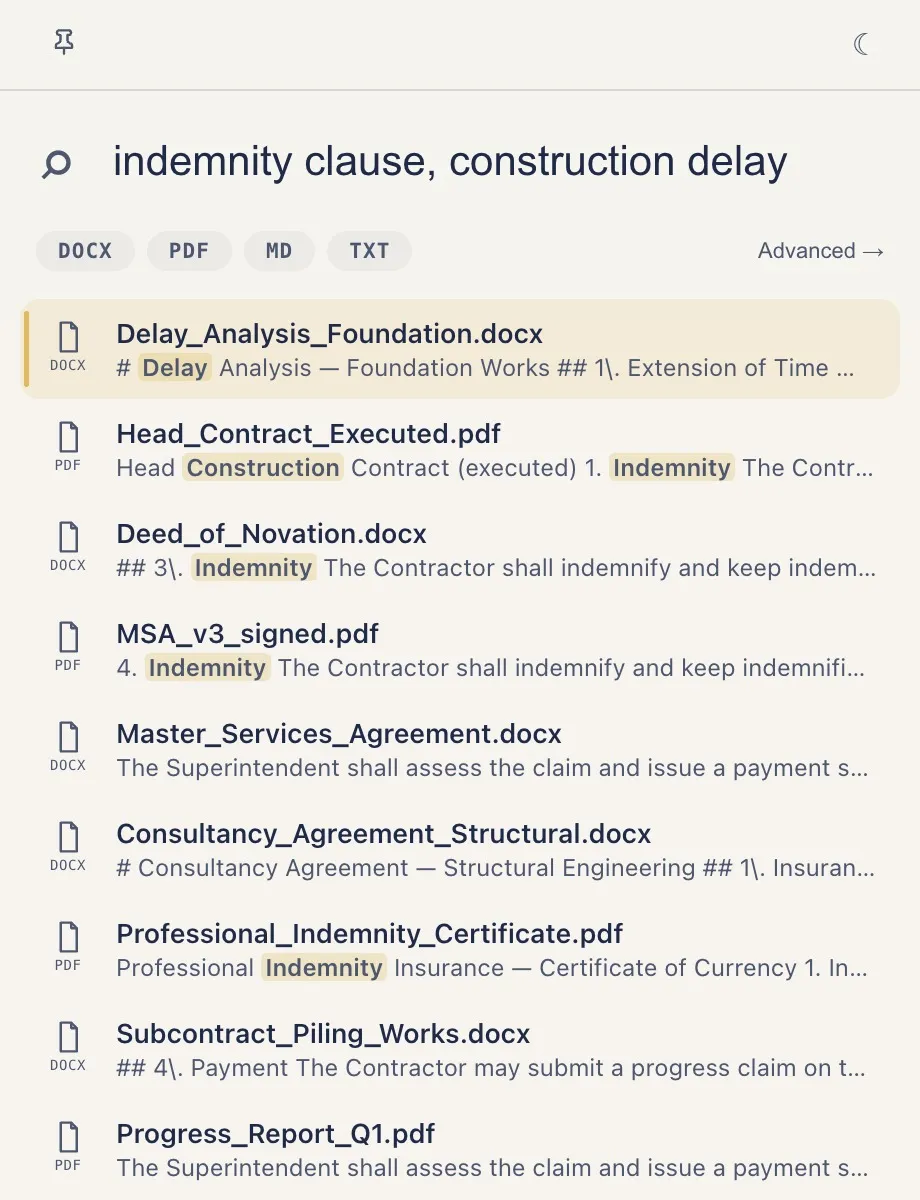
Fossick is a desktop app for Windows and Mac that searches your local documents by meaning, entirely offline. You point it at the folders where your reports live, it builds an index on your machine, and then you search by topic instead of by filename.
A few things worth being precise about:
- It's search, not chat. Fossick finds and ranks the relevant reports and shows you where the match is. There's no chatbot, no generative AI, and it does not summarise or answer questions — it takes you to the source document so you can trust what you read.
- It's genuinely offline. Indexing, embedding, and search run on-device. You can unplug the Wi-Fi and it still works. Documents are never uploaded; only licensing touches the internet.
- It handles messy archives. PDFs, Word files, and text are all searchable, and it runs OCR on scanned PDFs and images automatically — so a report that only exists as a scan is still findable by topic.
For teams that keep older work on network storage, searching a shared drive by meaning uses the same approach across many files at once.
A workflow for old reports you'll need again
Retrieval gets dramatically easier when the archive is indexed once and searchable forever. A practical setup:
- Index the folders where reports accumulate — project directories, an "archive" drive, downloaded email attachments.
- Include the scans. Board packs, signed reports, and old faxes-turned-PDFs often hold the details you'll want later; OCR makes them searchable by content.
- Search by subject when the need arises. Describe the report; open the top candidates; verify against the original text.
Because it's a one-time desktop install rather than a per-file upload, the cost of keeping years of reports searchable is essentially zero effort after setup. Fossick is a one-time US$14.99 purchase with a 14-day money-back guarantee, and the price is a single payment — no subscription, nothing to cancel. You can also read how consultants find past decks fast for a role-specific view.
Frequently asked questions
How do I search reports by topic when I don't remember the filename?
Describe the report's subject or conclusion in plain language rather than guessing the name — for example, "analysis recommending we delay the product launch." Semantic search matches the meaning of your description against the meaning of the text, so it can surface the right report even when the filename is uninformative or the exact wording differs.
Can I find a report if I forget the exact words it used?
Yes — that's the core advantage of topic-based search over keyword search. If the report said "employee turnover" and you search "staff attrition," a semantic search still finds it because the two phrases mean the same thing. Keyword search would return nothing.
Does searching reports by topic require uploading them to the cloud?
Not with an on-device tool. Fossick indexes and searches your reports entirely on your own machine, so the files never leave your computer. It works with the Wi-Fi unplugged; only licensing and billing touch the internet.
Can it search scanned reports and old PDFs?
Yes. Fossick runs OCR automatically on scanned PDFs and images, on-device, so reports that only exist as scans become searchable by their content. That's essential for older archives where signed or printed reports were filed as images.
Does Fossick summarise or answer questions about my reports?
No. Fossick is search, not chat — it finds and ranks the relevant reports and takes you to the matching text so you can read the source yourself. There's no generative AI, no summaries, and no chatbot, which keeps the results verifiable against the original document.